How to apply for the Smart Export Guarantee
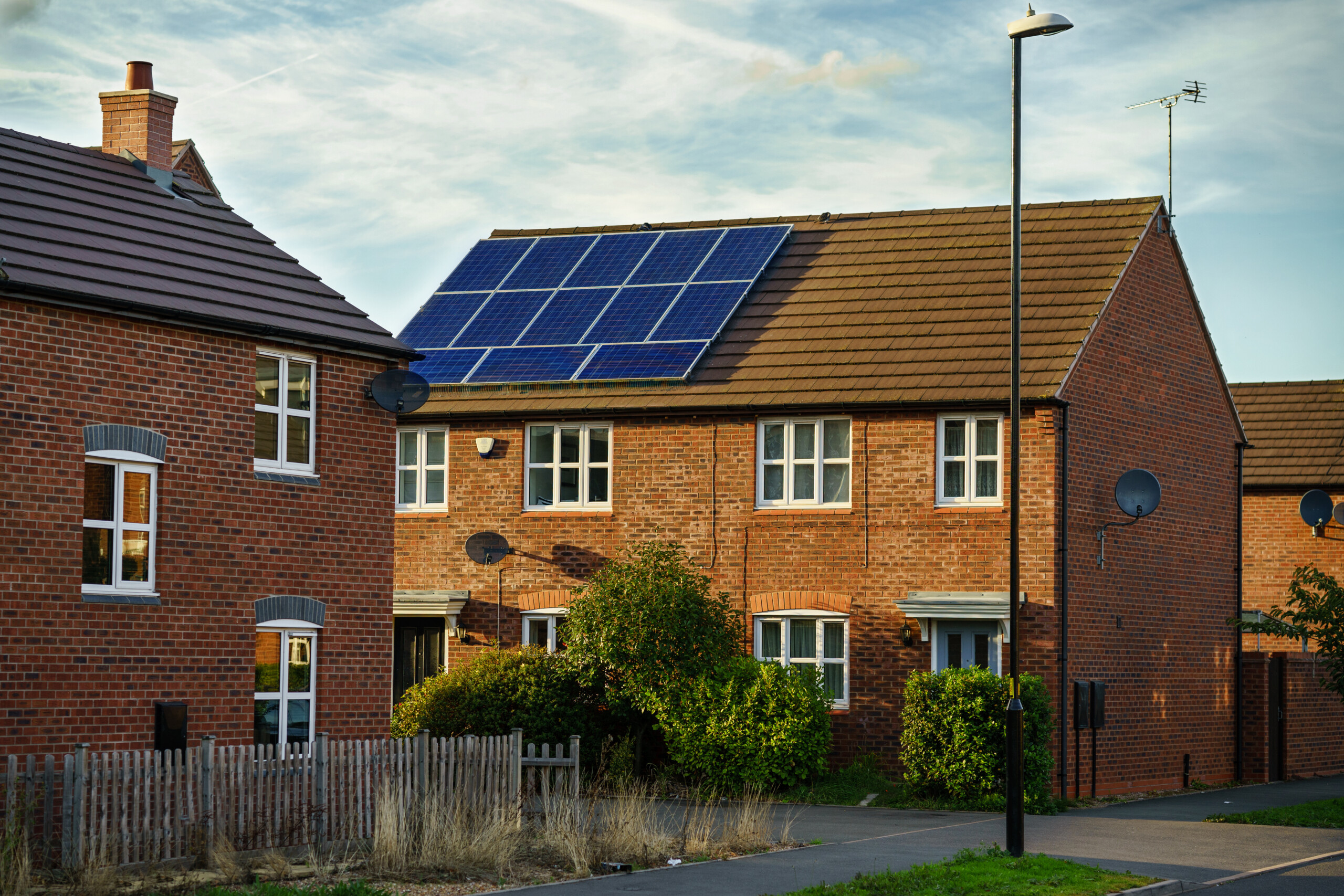
The Smart Export Guarantee (SEG) is a way for some households that generate electricity to be paid for the electricity they export to the grid. If your home has solar PV panels, you might be eligible to receive SEG payments.
Are SEG payments worth it?
The SEG is free to apply for. It’s a good option for all households that have solar panels, and especially good if you don’t have a battery to store your excess solar energy.
If you had eight solar panels and were home using energy all day, you could expect to be paid around £200 each year for your excess exported energy. For a more accurate estimate of what you might earn, explore our free online tool Solar Wizard.
Although it might be tempting to maximise how much energy you export, it’s best to first use as much of your solar energy as possible, by using energy during the periods when your solar panels are generating (in the middle of the day). While you’ll export less energy and receive less money via SEG payments, you’ll save more money than this on your energy bills. See our advice on how to do this.
Similarly, if you have a battery you’ll receive less via SEG payments because you’ll be storing most of the solar energy for your own use, rather than exporting it. While you won’t earn so much via SEG, you’ll instead see more savings on your energy bills.
Who pays the highest SEG rates?
Different suppliers offer different payment rates per kWh of electricity that you export. These are sometimes referred to as SEG export tariffs. Rates can vary from 1p to 25p per kWh, so it’s worth comparing suppliers. You don’t have to choose your current energy supplier to pay your SEG payments, but you might get a higher rate if you’re already an existing customer.
You can use Which?’s SEG comparison table to compare the different SEG rates and find the supplier that offers the best SEG tariff for you.
How do I know if I’m eligible for SEG payments?
To be eligible for the SEG, your solar PV panels need to have been installed by a company registered with either MCS or Flexi-Orb at the time of installation. MCS and Flexi-Orb are companies that verify the quality of the panels and the installation process.
In most cases, you’ll also need a smart meter that can track how much electricity you export. If you don’t have a smart meter, see our FAQs for more details.
If your panels were not installed by an MCS or Flexi-Orb registered company, you won’t be eligible for the SEG. See our FAQs below for more information.
If you’re not sure whether your installer was registered, you should check with them directly.
What you’ll need before applying
Once you’ve chosen a supplier, you’ll need to send them some paperwork. There are three separate documents that you’ll likely need:
- An MCS or Flexi-Orb certificate.
- A proof of grid connection letter.
- Proof that the panels belong to you or that you’re authorised to receive payments.
You should make sure you have these before starting your application, as it will mean that your application process runs more quickly and smoothly.
Need help with your application?
If you need support during any stage of the process, please reach out to our advice team and we’ll be happy to help you.
Step 1: Getting an MCS or Flexi-Orb certificate
The company that installed your solar PV panels should have provided you with either an MCS or Flexi-Orb certificate on completion of the installation.
See the image below for an example of an MCS certificate.
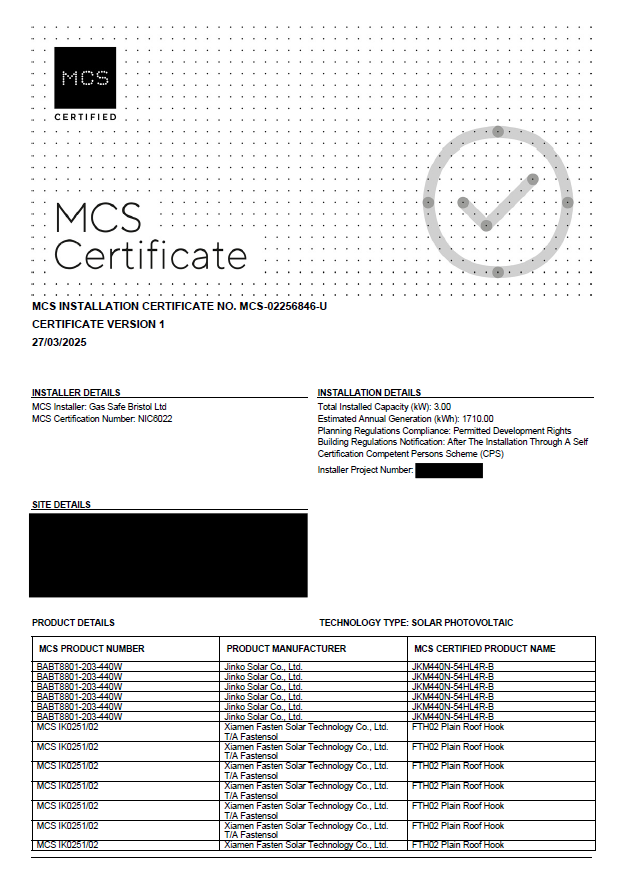
If they didn’t provide you with a certificate, or if you’ve since lost your certificate, there are a couple of options for getting a copy:
- If the company is still registered with MCS or Flexi-Orb, contact them and explain that you need a copy of your MCS or Flexi-Orb certificate for the solar panel installation.
- If the company is no longer registered, you’ll need to apply for a copy of your certificate directly from either MCS or Flexi-Orb.
Contact MCS to explain that you need a copy of your certificate. They’ll send you an application form. There’s an admin fee for this service (currently £36).
To contact Flexi-Orb,call their helpdesk on 0330 335 3382, email info@flexi-orb.com or use the Flexi-Orb contact form.
Step 2: Getting a proof of grid connection letter
Your installer should supply you with a proof of grid connection letter, also called a “DNO G98” letter, as part of the handover process after they’ve installed your solar panels. If your installer is registered with MCS and they don’t provide you with this letter, you can complain to MCS.
See an example of the letter below.
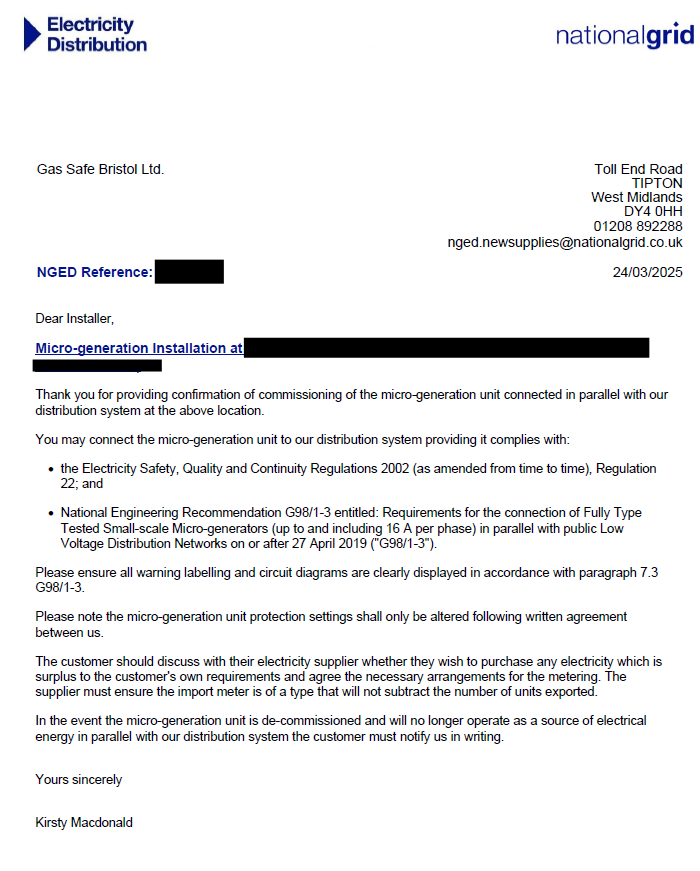
If you’re not in touch with the installer, for example if you’ve moved into a house with solar panels already installed, you can request this letter yourself from your Distribution Network Operator (DNO). Your DNO helps connect your home to the grid and is different from your supplier. Find the DNO for your area here.
If your DNO is National Grid, you can make an online application here. If you need help with this, contact National Grid on 0800 0963080 for support.
Step 3: Getting proof that the panels belong to you or that you’re authorised to receive payments
If you’re a homeowner, you might need proof that your solar panels belong to you, such as your receipt for the installation. If the panels were already there when you bought the house, you might be asked for proof that the solar panels were included in the sale of the property.
If you’re a tenant and your home is privately rented, council-owned or owned by a housing association, you’ll need a letter from your landlord confirming that they’re happy for you to receive the SEG payments. This letter should confirm the property address, state that the tenant is authorised to receive SEG payments, and confirm the name and address of the authorising person or department. You might also need to supply your tenancy agreement.
Applying for SEG with your chosen supplier
Send these three pieces of proof to your chosen supplier and follow any additional instructions they’ve given you.
The supplier will then register your export MPAN, a ‘Meter Point Administration Number’ that means you can get paid for what you export to the grid. Once they’ve done this, you’ll need to provide your supplier with an initial export meter reading.
This can take 5-12 weeks* to set up, but once done your payments should be backdated to your application date.
*Figures from MoneySavingExpert.
Need help with your application?
If you need further support with your application, our expert, friendly advisors will be happy to guide you through the process.
FAQs
We’ve answered some frequently asked questions about applying for the Smart Export Guarantee. If your question isn’t addressed below, please don’t hesitate to get in touch.
If your solar panels were not installed by an MCS or Flexi-Orb registered company, you won’t be able to receive SEG payments. Unfortunately, you can’t get certification for work that’s already been done.
You can still make the most of your solar PV through shifting your energy use or installing new technologies.
This will depend on the supplier. If you don’t have a smart meter, you should contact the supplier to discuss how your export meter readings will be taken. Otherwise, you could look into getting a smart meter. See our advice page on smart meters for more information about upgrading.
You can check this in a few different ways, depending on your situation. Contact us and we can help you find your installer.
You can register a complaint with your supplier. If it’s not resolved within eight weeks, you can raise your complaint with the Energy Ombudsman. Find out more about how you can make a complaint with your supplier.
You can also contact us for further advice and support.
If you had solar panels installed between 2010 and 31 March 2019, you may be on the Feed-in Tariff (FIT) instead, a scheme that pays you for both the electricity you generate and the electricity you export to the grid. SEG offers no payments for generated electricity, but SEG export tariffs usually pay more than FIT export tariffs, so it might be worth looking into switching to SEG for your exported electricity only. For more information on switching to a SEG tariff for your exported electricity, see MoneySavingExpert’s advice here.
Contact us for further help with your application. Our expert, friendly advisors will be happy to answer your questions and guide you through the application process.
-
Resource

DIY energy survey for community buildings
How to make facilities such as community centres, village halls and other shared spaces energy efficient.
Community energy Insulation & heating Building performance -
Advice

Solar PV
How solar PV works, the costs, the installation process and the grants available.
Renewable energy An energy efficient home -
Advice

Making the most of your solar pv panels
Maximise the benefit of your solar panels by thinking differently about how and when you consume electricity.
Saving money Your energy supply Renewable energy An energy efficient home -
Advice

Smart meters
Smart meters give you more information about your gas or electricity use and help you save energy.
Your energy supply Smart energy -
Advice

Battery storage
Batteries allow you to store the excess electricity you generate at home. But are they always a good idea?
Renewable energy Smart energy An energy efficient home