Early-stage delivery for local authority energy planning
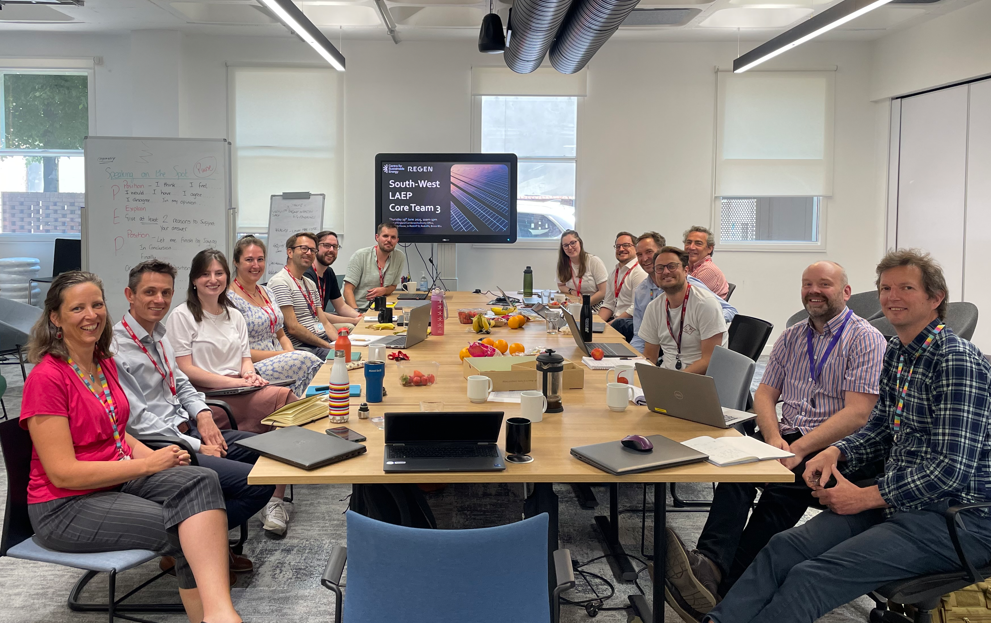
The Centre for Sustainable Energy (CSE) and Regen supported four local authorities in the south west to strengthen their readiness for local energy planning and future delivery.
Working alongside Devon, Dorset, Gloucestershire and Wiltshire councils, the project, commissioned by the South West Net Zero Hub, focused on establishing the foundations needed to support long-term action. This included developing a shared technical and non-technical evidence base, strengthening governance arrangements, supporting stakeholder engagement, and helping each authority identify clear priorities and practical next steps through delivery-focused Forward Plans.
The project was invaluable in helping Dorset work with other southwest councils to clarify the aims of energy planning and the problems we’re trying to solve with stakeholders. It has given us the confidence to pursue energy planning without relying on an expensive off-the-shelf LAEP solution.
Dorset Council
Understanding local readiness: what we did
CSE led the development of a non-technical evidence base for the four local authorities. This focused on understanding the wider factors shaping local energy planning in each area, including organisational capacity and capability, stakeholder relationships, previous project delivery experience, and relevant local strategies and policies.
While an LAEP is often associated with technical modelling, the project found that progress was frequently shaped by these non-technical factors.
CSE also led stakeholder engagement across the four areas, identifying key individuals and organisations whose perspectives helped inform the evidence base, build momentum and shape future priorities.
Through the baselining and stakeholder engagement, key priorities began to emerge. These were refined alongside the local authorities and formulated into Forward Plans that set out priority actions, delivery timescales, resource requirements and where additional support would be needed.
The regional approach: connecting, sharing and learning together
While each local authority received tailored support, a defining feature of the project was its regional approach. By combining resources across four local authorities, the programme created economies of scale that enabled a deeper level of support and analysis than many councils would have been able to access individually.
At the same time, authorities were able to learn from one another, compare approaches and explore common barriers to delivery, whilst retaining the flexibility to ensure work ‘on-the-ground’ in each area reflected local circumstances. The project also provided an early example of how emerging regional energy planning arrangements could work in practice. Bringing together organisations such as NESO, National Grid Electricity Distribution and Wales & West Utilities alongside local authorities created opportunities for collective dialogue that may have been difficult to achieve through individual engagements.
This helped identify shared priorities across the region, strengthened relationships between key organisations and informed future capacity-building support from the South West Net Zero Hub. Collectively, it demonstrated how regional coordination can create outcomes that are greater than the sum of their individual parts.
Key insights for future implementation
The experience of working with four local authorities generated a number of practical insights for places seeking to move from ambition to action on local energy planning.
Further detail is available in the full project report.
Key learnings
Three key learnings from the project were:
Non-technical factors are critical to successful local energy planning
Governance, organisational capacity, stakeholder relationships and local priorities all play an important role in determining what can be delivered in practice. Technical evidence is most valuable when combined with an understanding of these wider factors.
Good engagement tools create better conversations and better decisions
The most effective tools were those that enabled meaningful conversations between stakeholders. By building shared understanding, exploring different perspectives and surfacing challenges early, they helped create stronger outputs and more robust next steps.
Progress can start before a full LAEP
Local authorities can make significant progress before commissioning a full LAEP. Activities such as stakeholder engagement, governance development, priority-setting and delivery planning can help clarify what evidence, analysis and support are actually required. By understanding local needs first, authorities can commission the work that will add most value at a given time, rather than defaulting to a standard LAEP process regardless of need.
Governance, organisational capacity, stakeholder relationships and local priorities all play an important role in determining what can be delivered in practice. Technical evidence is most valuable when combined with an understanding of these wider factors.
Strengthening the Foundations for Local Energy Action: a toolkit
A significant legacy of the project was the development of ‘Strengthening the Foundations for Local Energy Action‘, a practical toolkit that captures the tools, approaches and lessons developed through work with the four participating local authorities. It is hoped that other councils will use this to help them assess their readiness for local energy planning, engage stakeholders and identify credible next steps.
-
Project

Local Authority Partnership Readiness Programme
Supporting local authorities and community energy organisations in the South West to build the foundations for local energy action.
Community energy Planning -
Project

Mission Net Zero
We’re a key player in this £5m initiative, working with communities to speed up Bristol and the West of England’s transition to net zero.
Community energy Behaviour change -
News
Building collaboration between local authorities and community energy groups
New guidance provides resources, case studies and an assessment tool to help local authorities progress their work with community energy groups.
Community energy Planning -
Project
Regional energy planning and local authority capabilities
Exploring the capabilities local and regional authorities need to support regional energy planning.